
What is Crown?
A crown is a restorative procedure that helps reshape, resize and strengthen a tooth that has been broken or worn down by decay. Think of a crown as a type of cap that is attached to the tooth with an adhesive. It acts as the tooth’s outer surface, protecting it from further damage and helping patients avoid more serious procedures like extractions or root canals.
Crowns are made from either porcelain or metal or a combination of the two. Porcelain is the most popular material as it closely resembles the natural color of teeth and is extremely durable. Their durability and strength are paramount as the crown must withstand the daily rigors of chewing and biting.
Partial crowns are used when a tooth or a series of teeth don’t require a full dental crown but are too far gone for a simple filling. Often called Onlays, a crown helps restore strength to a weakened tooth. Partial crowns also help prevent tooth decay and keep the structure of your teeth intact.
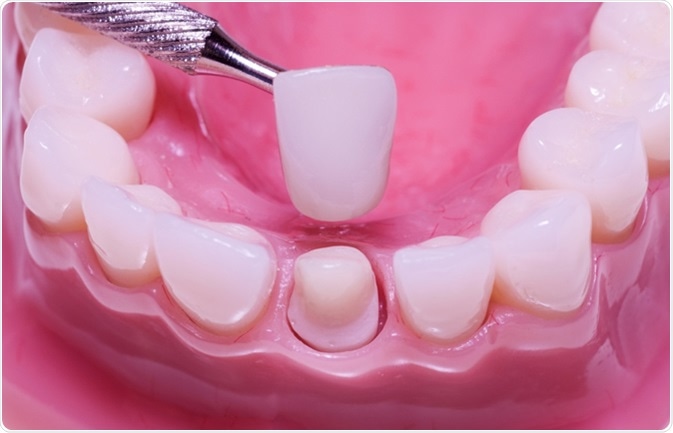
While not always necessary, temporary crowns can protect a tooth as you wait for the permanent crown or a root canal. This helps a patient eat without pain or further damaging the tooth. It is held in place with a cement that is less firm than traditional dental cement so that it can be easily removed when the time comes.
All crowns are manufactured in a lab and are based on an impression of your bite and jaw. This impression allows a technician to examine the movements of your jaw with respect to biting and then sculpt a crown that will fit your tooth and allow for normal function.
Types Of Crowns
Different kinds of materials can be used in crowns, including:
- porcelain
- ceramic
- zirconia
- metal
- composite resin
- a combination of materials
For example, you could have a porcelain crown that’s fused to metal, as opposed to an all-porcelain crown.
When selecting the material for your crown, your dentist will consider factors such as:
- your tooth’s location
- how much of the tooth will show when you smile
- position of your gum tissue
- the function of the tooth that needs the crown
- how much natural tooth is remaining
- color of the surrounding teeth
You can also talk with your dentist about your personal preference.
How Crowns Are Made?
You will typically have two visits to the dentist to prepare for a dental crown. In some cases, you may have a dental crown made in your dentist’s office.
The first visit
During the first visit, the tooth that’s going to receive the crown is examined and prepared. X-rays are taken of the tooth and the bone around it. Your dentist might have to do a root canal treatment before your dental crown procedure if there’s any:
- Tooth decay.
- Risk of infection.
- Injury to the tooth’s pulp.
Pulp is the soft tissue inside your teeth that contains blood vessels, nerves, and connective tissue.
The tooth that’s receiving the crown will be filed down across the top and sides. This will make space for the crown itself. The amount of tooth that gets filed away depends on the type of crown you have. All-metal dental crowns are thinner and don’t need as much of the tooth removed as all-porcelain or porcelain-fused-to-metal crowns. If too much of your tooth is missing — due to damage or decay — a filling material can be used to “build up” enough tooth structure for the crown to cover.
After reshaping the tooth, a paste or putty is used to make a copy (also called an impression) of the tooth that’s going to receive the crown. Impressions of the teeth above and below the tooth that’s getting the dental crown will also be made. This is done to make sure that the crown will not affect your bite.
The impressions are sent to a dental laboratory. The laboratory makes the crowns and usually returns them to the dentist’s office in two to three weeks. During this first office visit, your dentist will make a temporary crown to cover and protect the prepared tooth while you’re waiting on the permanent crown.
The second visit
At the second visit, the permanent crown is placed on your tooth. First, the temporary crown is removed and the fit and color of the permanent crown are checked. If everything is okay, a local anesthetic (“numbing” drug) is sometimes used to numb the tooth and the new crown is permanently cemented in place.

Same-day dental crowns
Dental crowns can also be made in a dentist’s office if your dentist has the equipment. This process starts off similarly to the traditional way a crown is made — the first steps are to remove decay and shape the tooth for a perfect fit inside the crown. After these steps, the actual making of the crown is different. In the same-day procedure, a scanning device (a “wand”) is used to take digital pictures of the tooth inside your mouth. The computer’s software creates a 3D model of the tooth from these pictures. The digital design is then sent to another in-office machine that carves the shape of the crown out of a block of ceramic. This method of making a dental crown is called computer-aided design/computer-aided manufacturing (CAD/CAM). In less than 15 minutes, the crown is ready to be cemented into place.


0 Comments